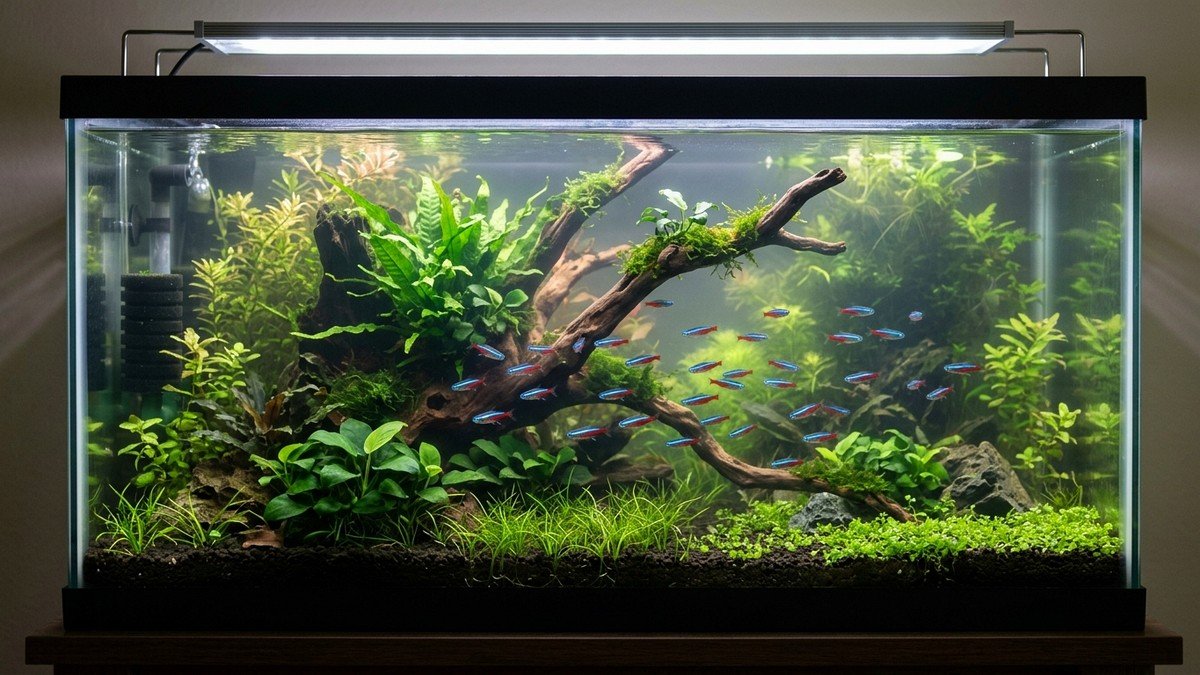
Achieving crystal-clear, pristine water is the hallmark goal of every aquarium hobbyist. Yet, few issues cause as much anxiety as waking up to discover your previously pristine aquarium filled with milky, greenish, or murky water. Cloudy aquarium water is one of the most common complaints in the aquatic hobby, especially among newcomers who mistakenly assume that cloudy water requires immediate, massive water changes.
Fundamental Aquatic Rule
Cloudy water is a symptom, not a disease. Accurately diagnosing the visual tint (milky white, green, grey silt, or amber brown) is the only way to apply the correct biological, mechanical, or chemical solution without crashing your nitrogen cycle.
1. Milky White Cloudiness: The Bacterial Bloom
By far the most frequent culprit in newly established or disrupted aquariums is a heterotrophic bacterial bloom. Unlike the beneficial autotrophic nitrifying bacteria (Nitrosomonas and Nitrospira) that colonize filter media and gravel to process ammonia, heterotrophic bacteria reside in the water column and consume organic waste.
When an aquarium experiences an influx of organic matter (such as overfeeding, decaying uneaten pellets, dying plant leaves, or an uncycled filter), heterotrophic bacteria reproduce at an exponential rate, doubling their population every 20 minutes. Millions of these microscopic organisms create a dense milky haze.
The biggest beginner mistake is performing massive water changes to clear it. Fresh tap water provides fresh mineral nutrients that fuel another bacterial explosion within hours. The correct treatment is patience, stopping all feeding for 48 hours, and maximizing surface agitation with an air pump, as these bacteria consume vast amounts of oxygen.
2. Emerald Green Water: Algae Bloom
If your water develops a vibrant pea-soup green tint, you are dealing with a bloom of microscopic free-floating single-celled algae (such as Volvox or Euglena). Unlike bacterial blooms, algae blooms require two primary catalysts: excessive photoperiod (light) and elevated dissolved nutrients (nitrates and phosphates).
Aquariums positioned near direct sunlight, or tanks with LED lights running 10 to 14 hours per day, are prime candidates. Standard mechanical filter sponges cannot trap free-floating algae because the individual cells are microscopic (under 10 microns in size). Solving green water requires either an inline ultraviolet (UV) sterilizer, which bursts the cellular walls of the algae, or a strict 72-hour total blackout.
3. Grey or Brown Haze: Mechanical Particulates and Substrate Dust
If cloudiness appears immediately after setting up a tank, adding new sand, or vacuuming the substrate aggressively, the haze is purely mechanical. Substrates contain fine pulverized rock and clay dust that suspends easily in water currents.
This form of cloudiness poses no chemical threat to fish, though abrasive particles can irritate sensitive gills if allowed to linger. The solution is straightforward: install a dense layer of fine polyester filter floss or water-polishing pads inside your power filter. Within 12 to 24 hours, the floss traps the particulate matter, restoring clarity.
4. Amber or Tea-Colored Water: Driftwood Tannins
Tannic acids leached from natural aquarium driftwood (such as mopani, Malaysian driftwood, or spider wood) tint the water a yellow or amber hue. While often confused with dirty water, blackwater environments rich in tannins are extraordinarily beneficial for South American and Southeast Asian fish like tetras, angelfish, and bettas, naturally boosting their immune defenses and lowering pH.
If you prefer crystal-clear water for aesthetic reasons, adding activated carbon or synthetic macroporous polymer resins (such as Seachem Purigen) into your filter will completely adsorb tannins within 24 hours.
Comprehensive Aquarium Water Cloudiness Diagnostic Guide
Use this diagnostic table to determine the exact nature of your tank’s cloudiness and the proven treatment:
| Visual Color | Underlying Cause | Danger to Fish | Effective Solution |
|---|---|---|---|
| Milky / Cloudy White | Heterotrophic bacterial bloom | Oxygen depletion risk | Add aeration, pause feeding for 48h, wait 3 to 5 days |
| Pea-Soup Green | Microscopic floating algae bloom | Low (harmless, but unsightly) | 72h blackout, inline UV sterilizer, reduce lighting |
| Grey / Murky Silt | Substrate dust, unrinsed gravel | Mild gill irritation if heavy | Install fine polyester filter floss pads |
| Yellow / Tea-Colored | Tannic acid leaching from wood | Beneficial natural health boost | Add activated carbon or synthetic resin to filter |
5. Long-Term Maintenance Rules to Prevent Cloudiness
To keep your aquarium water crystalline and biologically robust year-round, follow these foundational husbandry guidelines:
- Practice the Two-Minute Feeding Rule: Feed only what your fish can consume completely within two minutes. Uneaten flakes sinking into the gravel bed are the primary cause of excess organic waste and bacterial blooms.
- Never Rinse Filter Media in Tap Water: Chlorinated municipal tap water instantly destroys nitrifying bacteria colonies, causing sudden nitrogen cycle collapse. Always rinse biological filter sponges in discarded tank water during water changes.
- Conduct Consistent 20 Percent Weekly Water Changes: Regular, modest water changes dilute nitrates and organic waste without shocking water chemistry or destabilizing microbial equilibrium.
Helpful Related Guides for Aquarists
If you are establishing a new tank or maintaining water quality, read our essential guides on how to cycle a fish tank properly and the best freshwater fish for beginners.
Frequently Asked Questions (FAQs)
1. Why did my fish tank turn cloudy white overnight?
A sudden milky white haze is almost always a heterotrophic bacterial bloom. These free-floating aerobic bacteria reproduce rapidly when excess nutrients such as unconsumed fish food, decaying organic matter, or dead plant leaves accumulate in an unestablished aquarium.
2. Should I do a 50 percent water change for cloudy water?
No. Performing large water changes during a bacterial bloom usually exacerbates the problem. Removing water removes some bacteria but introduces fresh trace minerals and nutrients, prompting the remaining bacteria to multiply even faster. The best approach is increasing aeration and waiting 3 to 5 days.
3. How do you get rid of green aquarium water?
Green water is caused by free-floating microscopic algae. The most effective solutions include an inline UV sterilizer, executing a 72-hour total blackout (covering the tank completely with opaque blankets), reducing light to 6 hours daily, and addressing elevated phosphates.
4. Can cloudy water suffocate or kill aquarium fish?
Yes. Severe heterotrophic bacterial blooms consume massive quantities of dissolved oxygen from the water column. If fish are gasping at the surface, immediately add an air stone or raise the filter outflow to create surface agitation and restore oxygen levels.
5. Why does new substrate make aquarium water cloudy?
Aquarium gravel, sand, and clay substrates contain fine mineral dust and particulate matter from manufacturing. If not rinsed repeatedly prior to filling the tank, this dust suspends in the water column. Fine filter floss (polishing pads) will clear it within 24 hours.
6. Are water clarifying chemicals safe for all fish and plants?
Flocculants and water clarifiers bind microscopic particles together so your filter can trap them. While generally safe, they must be used strictly according to dosage, as excess flocculants can coat fish gills, and they do not resolve underlying biological filtration imbalances.