
Bringing home a vibrant, cheerful parakeet (budgerigar) is a joyous experience, but for many new owners, initial excitement quickly gives way to discouragement. When you approach the cage, your new pet flutters frantically against the bars, panting with terror as if you are a hungry hawk. Transforming a timid, fearful prey animal into a loyal, affectionate companion that willingly flies to your shoulder and perches on your finger is entirely achievable through modern, force-free operant conditioning.
Golden Rule of Avian Training
Trust cannot be demanded from a prey animal; it must be earned through patient, predictable positive association. Never grab or chase your bird with your hands.
Phase 1: Acclimation and Calm Proximity (Days 1 to 4)
When your budgie first arrives in your home, its world has been turned upside down. The sounds, scents, room dimensions, and human silhouettes are completely novel and threatening. During the first 72 hours, avoid putting your hands inside the cage except for essential food and water changes.
Instead, pull up a comfortable chair beside the cage. Read a book, work on a laptop, or talk softly in gentle, rhythmic tones for 15 to 20 minutes multiple times a day. This teaches the bird that your physical presence does not equal an imminent predator attack.
Phase 2: The Magic of Spray Millet Conditioning (Days 5 to 10)
Golden spray millet is the universal currency of the parakeet world. Remove any spray millet from their permanent food dishes; this delicacy must now be associated solely with you.
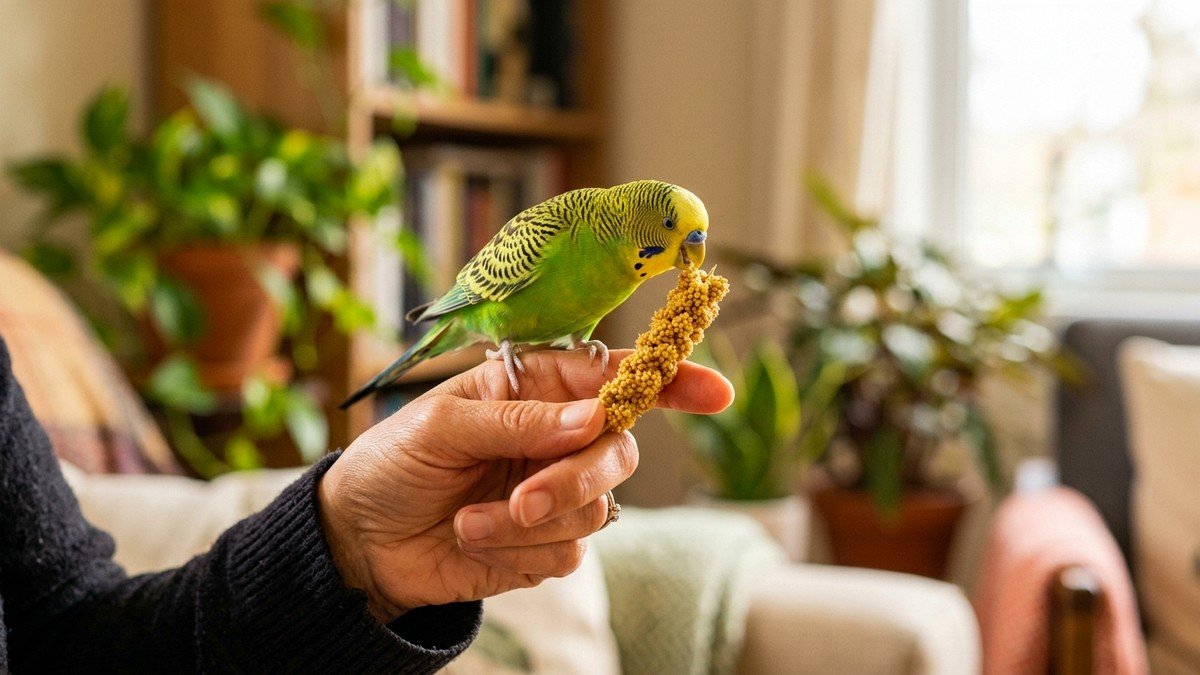
Cut a long sprig of millet (about 8 inches). Slowly rest your hand near the open cage door, holding the very end of the millet stalk so the seed cluster extends close to your bird’s favorite perch. Do not move your hand. Wait patiently. Driven by natural curiosity and appetite, your budgie will eventually lean forward, stretch its neck, and nibble the seeds. Repeat this until the bird eats eagerly without hesitation.
Phase 3: The Hand Bridge and Finger Perching (Days 11 to 18)
Once your parakeet eats confidently from a held millet sprig, shorten the distance between your fingers and the seed cluster. Gradually, hold the millet so the bird must place one foot on your index finger to reach the food.
When the bird places one foot on your finger, maintain complete stillness and allow it to feast for 30 seconds. In subsequent sessions, position the millet so the bird must place both feet on your horizontal finger. Pair this moment with the gentle verbal cue Step Up. Your finger is now officially recognized as a safe, rewarding perch.
Parakeet Taming Milestone Roadmap
Follow this sequential milestone checklist to guide your daily training sessions:
| Training Phase | Action Technique | Expected Timeframe | Success Criteria to Advance |
|---|---|---|---|
| 1. Passive Presence | Sit beside cage, talk softly, read aloud | Days 1 to 4 | Bird does not panic or flap when you approach |
| 2. Long-Stem Millet | Offer 8-inch millet sprig through door | Days 5 to 10 | Eats eagerly from held millet within 10 seconds |
| 3. One-Foot Perch | Hold millet behind index finger bridge | Days 11 to 15 | Places one foot onto finger without hesitation |
| 4. Full Step-Up | Press finger gently against lower breast | Days 16 to 21 | Steps up on cue, sits calmly, eats treat |
| 5. Out-of-Cage Freedom | Transport bird outside cage to safe room | Weeks 4+ | Flies to your hand/shoulder, enjoys time out |
Helpful Related Guides for Bird Owners
Deepen your avian care expertise by reading our essential guides on why budgies chirp and vocalize and safe and toxic foods for pet birds.
5. Prey Animal Ethology: The Biology of Parakeet Fear
To tame a parakeet (budgerigar), you must step into the mind of a prey animal weighing just 35 grams. In the Australian outback, wild budgies survive in nomadic flocks numbering in the thousands. Their primary survival mechanism is hypersensitive predator evasion:
- Monocular Vision and Blind Spots: Budgies have eyes positioned on the sides of their skull, giving them a 300-degree visual field to detect predatory falcons. A human walking directly toward them with both eyes forward looks identical to an approaching raptor.
- Rapid Tachycardia Response: A startled budgie’s heart rate spikes from 300 beats per minute to over 600 beats per minute within a split second, flooding their system with adrenaline and triggering blind panicked flight.
- The Threat of the Human Hand: To an untamed parakeet, five moving fingers resemble an approaching hawk claw or climbing tree snake intent on crushing their rib cage.
6. Clicker Training and Bridge Conditioning for Budgies
Positive reinforcement using a clicker or acoustic verbal bridge (‘Yes!’) accelerates trust-building exponentially compared to traditional force-handling:
- Charging the Clicker: Click the clicker (or make a soft tongue click) and immediately extend a tiny cluster of spray millet for the bird to take one nibble. Repeat this 20 times until the bird connects the sound with a high-value food reward.
- Target Stick Training: Present the blunt rounded tip of a wooden chopstick near the perch. When the curious budgie reaches forward to touch the tip of the stick with their beak, click and reward immediately.
- Guiding Movement: Once target trained, use the chopstick to guide your budgie across perches, out the cage door, and directly onto your forearm with zero fear.
7. Why Flight Feather Clipping Harms Trust-Building
Decades ago, pet stores routinely recommended clipping budgie primary flight feathers to force dependence during taming. Modern avian veterinarians and behavior consultants strongly condemn this outdated practice:
Clipping wings does not build genuine trust; it induces learned helplessness. A flightless bird that cannot escape human hands sits frozen in terror. Furthermore, attempting to fly causes clipped birds to crash onto hard floors, bruising their keel bone and splitting flight feathers. Preserving full natural flight empowers the bird with agency, ensuring that when they choose to step onto your hand, it represents genuine, unforced friendship.
8. The Four Environmental Keys to Parakeet Confidence
Your parakeet’s room environment directly influences their willingness to bond with you:
- Cage Positioning at Chest Height: Position the bird’s cage so their highest perch sits at your chest or eye level. Placing cages on the floor makes birds feel constantly stalked by giants.
- Solid Wall Anchor: Position the back of the cage against a solid wall rather than in the center of an open room. A protected back ensures the bird only needs to monitor 180 degrees of space.
- Soft Acoustic Enrichment: Wild budgies go silent only when a hawk is overhead. A completely silent house terrifies a parakeet. Play soft acoustic radio music, nature podcasts, or budgie flock sounds to signal safety.
Frequently Asked Questions (FAQs)
1. How long does it take to finger tame a parakeet?
With consistent 10-minute training sessions conducted twice daily, most budgies can be finger tamed within 2 to 4 weeks. Rushing the process or grabbing the bird with bare hands sets progress back significantly.
2. What is the best treat to use for taming parakeets?
Golden spray millet is the undisputed holy grail of parakeet training treats. Budgies find spray millet irresistible. Reserve millet exclusively as a hand-fed reward during training rather than leaving it in the cage.
3. Should you clip a parakeet’s wings to make it easier to tame?
Modern avian behaviorists strongly advise against wing clipping. Depriving a bird of flight induces learned helplessness and increases fear biting. Flighted birds trained through voluntary positive reinforcement develop greater confidence and bond deeper.
4. What should you do if your parakeet bites during training?
Never pull your hand away swiftly, shout, or flick the bird’s beak. Fast reactions turn biting into an entertaining game or confirm to the bird that biting succeeds in driving hands away. Stay still and remove the treat reward.
5. Can older parakeets be tamed, or only young babies?
While juvenile budgies (identifiable by forehead bars down to the cere) adapt more quickly, adult parakeets can be successfully tamed at any age with patient, treat-based counter conditioning.
6. Why is my parakeet terrified of my hands?
To a small prey bird weighing just one ounce, an approaching human hand looks like a five-taloned hawk or predator. Keeping your hand stationary while holding food teaches the bird that your hand is a benevolent dispenser of feasts.
Is it harder to tame a pair of parakeets compared to a single bird?
Yes. When housed in pairs, budgies naturally bond to each other first. Taming two birds requires working with them individually in separate short daily sessions with high-value spray millet.
How can I tell if my parakeet is relaxed during taming sessions?
A relaxed budgie grinds their beak rhythmically, preens their flight feathers, fluffs their cheek feathers over their bill, and rests comfortably on one tucked foot.
[…] how to build unbreakable trust with companion birds in our detailed guides on how to tame a parakeet step by step and why do cockatiels […]
[…] how to build unbreakable trust with companion birds in our detailed guides on how to tame a parakeet step by step and why do cockatiels […]