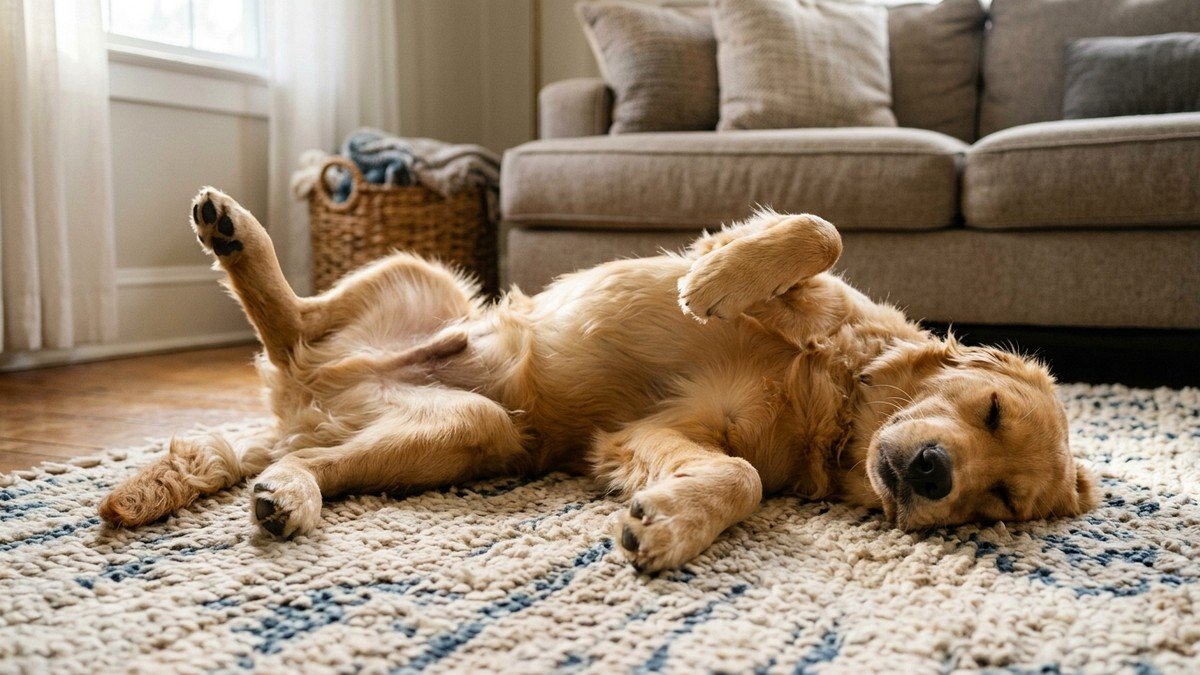
Walking into your living room to find your dog sprawled completely upside down with its paws dangling limply in the air is one of the most endearing sights for any pet parent. Known affectionately among veterinarians and trainers as the cockroach pose, this sleeping style is far more than a comical quirk. It provides profound scientific insights into canine thermoregulation, neurobiology, and emotional security.
Key Takeaway for Dog Owners
Exposing the vulnerable belly while sleeping is the ultimate canine compliment. It proves your dog feels 100 percent safe in its household environment while efficiently cooling its core body temperature.
1. Thermoregulation and Body Temperature Control
Unlike humans who regulate core body temperature through millions of eccrine sweat glands across the skin, canines have sweat glands located exclusively on their paw pads. While panting is their primary method of evaporative cooling, posture plays an equally important physical role.
A dog’s belly features significantly thinner skin and sparse hair coverage compared to the dense guard hairs protecting the spine and ribs. By sleeping on their back, dogs expose their abdominal blood vessels directly to indoor airflow or cool tile floors, shedding excess metabolic heat efficiently after periods of active exercise.
2. Complete Psychological Safety and Trust
From an evolutionary standpoint, the abdominal area contains all vital organ systems: the stomach, intestines, liver, and major vascular pathways. In the wild, wild wolves and coyotes never sleep on their backs in open terrain because an unexpected predator attack would prove instantly fatal.
Furthermore, rising from an upside-down position takes valuable seconds. When your domestic companion sleeps belly-up in your presence, it demonstrates that its central nervous system has powered down into deep parasympathetic relaxation. Your dog perceives zero threats and recognizes your home as an inviolable sanctuary.
3. Deep REM Sleep and Muscle Relaxation
When a dog sleeps curled up on its paws in a sphere, its abdominal, spinal, and leg muscles remain slightly tense, ready to spring into action at the slightest sound. Conversely, resting flat on the spine allows every major muscle group to release tension completely.
This state of full physical flaccidity facilitates entry into restorative Rapid Eye Movement (REM) sleep. During REM cycles, dogs process daily learning, consolidate memories, and dream. You will often observe twitching paws, lip fluttering, and quiet vocalizations while they rest on their back.
Canine Sleeping Positions and Their Meanings
Review this canine posture guide to understand how your pet’s sleeping position reflects comfort and health:
| Sleep Posture | Body Description | Primary Function | Emotional Status |
|---|---|---|---|
| The Cockroach (On Back) | Belly exposed, paws in air | Core cooling, complete muscle relaxation | Supreme confidence and security |
| The Donut (Curled Up) | Nose to tail, paws tucked underneath | Heat conservation, organ protection | Cautious, self-soothing, or chilly |
| The Side Sleeper | Legs extended straight sideways | Deep sleep cycle transition | Comfortable and trusting |
| The Superman | Front paws forward, back legs out | Belly floor cooling, quick nap | Energetic, ready to spring up |
| The Lion Pose (Sphinx) | Paws straight forward, head resting | Light dozing | Alert guard mode |
4. Relief for Senior Dogs with Joint Stiffness
Senior dogs diagnosed with degenerative joint disease or osteoarthritis often transition to back-sleeping. When lying on their side or stomach, the body’s entire gravitational weight presses down on the hips, shoulders, and elbow joints.
By rolling onto their back on an orthopedic memory foam bed, pressure is redistributed along the broader surface area of the dorsal spine, alleviating compressive pain in sensitive hip sockets. If an older dog begins sleeping on its back, ensure their sleeping quarters are draft-free and well-cushioned.
Helpful Related Guides for Dog Owners
Explore more fascinating canine health and behavioral insights in our veterinarian-reviewed guides on why dogs lick their paws excessively and why dogs shake their heads.
5. Evolutionary Differences: Why Wild Wolves Rarely Sleep Belly-Up
To truly appreciate why your domesticated dog curls their paws in the air, consider their evolutionary ancestors. In the wild, wolves (Canis lupus), coyotes, and feral dingoes rarely sleep flat on their backs. In an undomesticated habitat, sleeping with the abdominal cavity exposed presents grave biological hazards:
- Vulnerability to Apex Predators: The stomach houses vital organs including the liver, spleen, kidneys, and abdominal aorta, unprotected by the rib cage. An exposed belly in the wild invites lethal predatory strikes.
- Delayed Fight-or-Flight Response: A wild canid sleeping in the sternal sphinx position can leap onto its feet within milliseconds. Rolling over from a supine posture requires significant effort, leaving wild animals defenseless during ambushes.
- Hypothermia Hazards: Wild canids preserve body heat in cold weather by tucking their paws beneath their chest and draping their bushy tail over their nose. Exposing the bare belly in a wild den leads to rapid body heat loss.
Domestic dogs possess the evolutionary luxury of absolute safety inside human households. Generations of human cohabitation have selected for calm nervous systems, allowing dogs to cast aside predatory vigilance and sleep in postures wild wolves could never risk.
6. Decoding Involuntary Paws, Whimpers, and Twitching
Owners frequently witness their dog’s paws paddling the air, whiskers twitching, and muffled yips escaping their lips while resting upside down. Neurologists confirm this occurs during the Rapid Eye Movement (REM) phase of sleep.
During REM sleep, the brain stem structure known as the pons normally releases neurotransmitters (glycine and GABA) to paralyze major muscle groups, preventing the dog from physically acting out dreams. However, in juvenile puppies and senior dogs, this neural inhibition is incomplete. Mild twitching and vocalizations indicate active cognitive processing and memory consolidation from the day’s adventures.
7. When Supine Sleeping Indicates a Medical Issue
While sleeping belly-up is overwhelmingly benign, sudden behavioral shifts warrant clinical investigation:
- Environmental Contact Dermatitis: Dogs suffering from grass pollen allergies, flea allergy dermatitis, or bacterial folliculitis frequently flip onto their backs to rub irritated bellies against carpets or cool tile.
- Acute Abdominal Pain or Bloat: If an adult dog attempts to sleep upside down while whining, pacing, drooling, or exhibiting a distended, taut abdomen, seek immediate veterinary emergency care to rule out Gastric Dilatation-Volvulus (GDV).
- Spinal Disk Compression: Dogs experiencing intervertebral disk disease (IVDD) occasionally adopt awkward postures to decompress nerve roots along the lumbar vertebrae.
8. Selecting the Best Dog Bed for Back Sleepers
Dogs that sleep on their backs have specific orthopedic support requirements. Enclosed cave beds or tight circular donut beds restrict back sleeping. Consider these specialized bedding designs:
- High-Density Orthopedic Memory Foam: Flat mattress beds made from four-inch solid medical-grade memory foam support extended spines without bottoming out against hard subfloors.
- L-Shaped Bolster Chaise Lounges: Provide an open sleeping flat surface while offering one or two padded walls where your dog can prop their legs in the air securely.
- Elevated Breathable Cot Beds: Suspended mesh cot beds allow 360-degree ambient air circulation underneath your dog’s back, maximizing cooling during hot summer months.
Frequently Asked Questions (FAQs)
1. Why do dogs sleep on their backs with their paws in the air?
Sleeping belly-up with paws hanging in the air is known as the cockroach or dead cockroach position. Dogs adopt this posture because it allows their core muscles to relax completely, cools down their body through thin belly fur, and indicates complete trust in their surroundings.
2. Do wild wolves or stray dogs sleep on their backs?
Rarely. In the wild, exposing the soft abdominal cavity leaves vital organs vulnerable to predator attacks. Wild canines and fearful strays almost always sleep curled in a tight ball (the nose-to-tail tuck) to protect their organs and conserve body heat.
3. Does sleeping on their back help dogs cool down?
Yes. Dogs sweat minimally through their paw pads and cannot sweat through their skin. Because fur on a canine abdomen is thinner and holds fewer insulating follicles, exposing the belly to ambient air currents facilitates rapid heat dissipation.
4. Can older dogs with arthritis sleep on their backs?
Yes, many dogs suffering from hip dysplasia or spine stiffness find relief sleeping upside down because it removes direct gravitational pressure from aching joints and distributes their body weight evenly across the back muscles.
5. Why does my dog twitch or run while sleeping on its back?
Twitching paws, soft whimpers, and rapid eye movements indicate that your dog is in the deep rapid eye movement (REM) dreaming stage of sleep. Sleeping belly-up allows total muscular flaccidity, making dream twitches more noticeable.
6. Should I pet a dog when it is sleeping on its back?
It is best to let a sleeping dog rest undisturbed. While the posture signals trust, touching a dog in deep REM sleep can startle them awake, triggering an involuntary defensive startle reflex.
Do certain dog breeds sleep on their backs more frequently?
Yes. Breeds with deep chests and lean abdominal waists, such as Greyhounds, Whippets, Boxers, German Shepherds, and Golden Retrievers, frequently sleep on their backs to relieve pressure on their narrow sternums.
Why does my dog press their back legs against the wall while sleeping?
Pressing paws against cool drywall or baseboards provides additional thermal relief through conduction while stabilizing the dog’s posture so they do not tip over while in deep sleep.