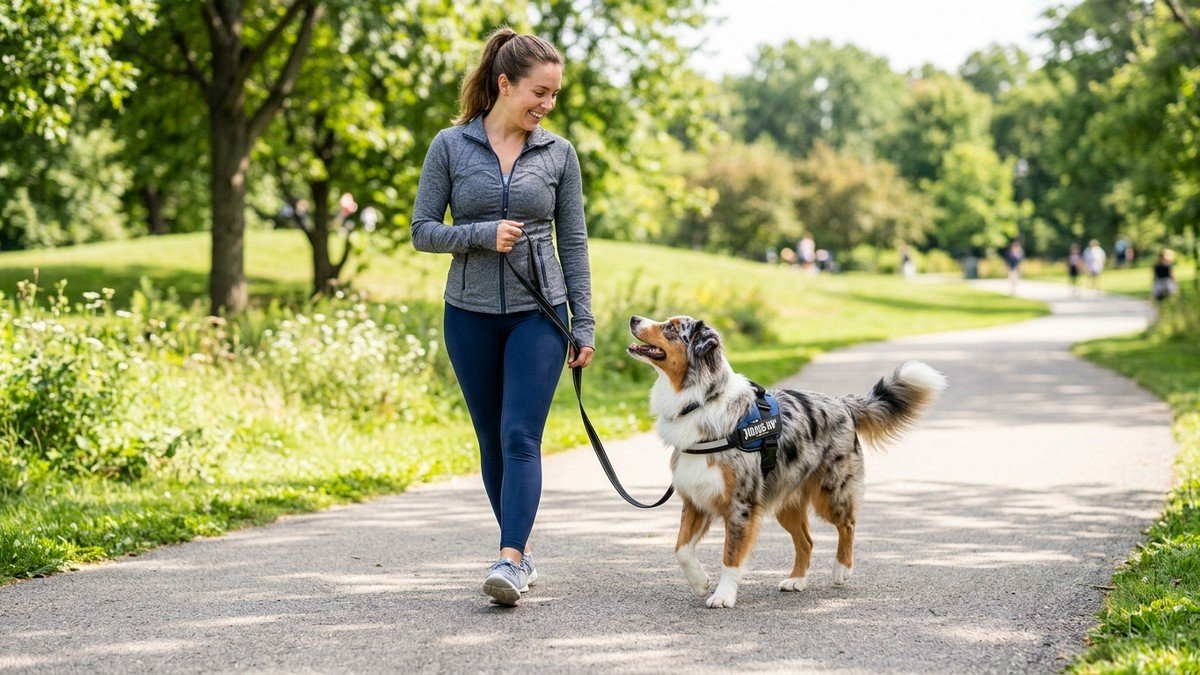
Daily walks are meant to be a relaxing, bonding highlight for both you and your canine companion. Yet for millions of pet owners, picking up the leash triggers a frustrating battle of wills that results in sore shoulders, strained wrists, and gasping, wheezing dogs. Leash pulling is among the most widespread behavioral complaints in the dog world, but it is also one of the most straightforward to resolve with modern behavioral science.
Fundamental Behavioral Insight
Dogs do not pull on the leash out of dominance or spite. They pull because forward momentum is self-reinforcing, and canines possess an involuntary neurological reaction called the opposition reflex that causes them to push against physical resistance.
1. The Physics and Biology of Leash Pulling
To solve pulling, you must understand your dog’s physiological baseline. The average adult human walks at approximately 2.5 to 3 miles per hour. A medium or large dog’s natural, relaxed trot clocks in between 4 and 6 miles per hour. Simply by matching human walking speed, a dog is being asked to operate at half-throttle.
Furthermore, whenever a collar tightens against a dog’s throat, the opposition reflex kicks in. If you push gently against a standing dog’s shoulder, its muscles automatically push back to keep from falling. Similarly, when a leash pulls backward on a collar, the dog’s body reflexively surges forward with increased power.
2. Selecting the Right Humane Equipment
Your choice of walking gear fundamentally influences your training success. Avoid equipment that damages health or actively encourages pulling:
- Front-Clip No-Pull Harness (Recommended): These harnesses attach the leash to the center of the chest rather than the back. When the dog lunges forward, the leash pivots their torso back toward you, eliminating pulling power safely.
- Standard 6-Foot Nylon or Leather Leash: Provides ideal slack for teaching loose-leash positioning while keeping your pet within safe physical control.
- Avoid Retractable Leashes: Retractable mechanisms maintain constant tension on the dog’s collar, teaching them that pulling hard extends the line.
- Avoid Neck-Tightening Collars: Choke chains and prong collars cause tracheal collapse, thyroid damage, and heightened fear reactivity.
3. The Red Light, Green Light Method
The most effective positive reinforcement protocol for polite walking is operant conditioning via environmental consequences:
- Step 1: The Red Light: The instant the leash becomes taut and forms a straight line, freeze immediately in your tracks like a rooted tree. Do not yank the leash or shout. Simply stop all forward motion.
- Step 2: Await Release of Tension: Wait patiently. Eventually, the dog realizes forward progress has ceased and will turn its head back toward you or take one step backward, creating slack.
- Step 3: The Green Light: The moment the leash forms a relaxed J-shape curve, immediately mark with Yes and take two steps forward.
- Step 4: Reward the Reinforcement Zone: Deliver high-value rewards (freeze-dried liver or string cheese) right beside your hip. The dog quickly discovers that staying near your leg unlocks both delicious treats and forward walking.
Comparison of Dog Leash Training Gear
Evaluate gear options according to safety, effectiveness, and comfort:
| Gear Type | Mechanical Effect | Safety Profile | Training Recommendation |
|---|---|---|---|
| Front-Clip Harness | Redirects forward momentum to side | Excellent: Zero neck or spine pressure | Highly Recommended for all pullers |
| Back-Clip Harness | Distributes pull across chest evenly | Safe, but triggers sled-pulling reflex | Use only for already trained dogs |
| Standard Flat Collar | Puts direct tension against the trachea | Risk of coughing and tracheal trauma | For ID tags only in heavy pullers |
| Retractable Leash | Maintains constant line pressure | High: Rope burn, lack of control | Never recommend for leash training |
Helpful Related Guides for Dog Owners
Discover our detailed equipment reviews and behavioral training advice in our guides on the best no-pull dog harness for large dogs and why dogs lick their paws.
5. The Dangerous Hazards of Aversive Training Tools
Frustrated owners often turn to quick-fix aversive tools, including metal prong collars, slip choke chains, and electronic shock collars. Certified veterinary behaviorists strongly discourage these devices due to severe physical and psychological trauma:
- Cervical Spine and Tracheal Trauma: Repeated sudden jerks against metal choke chains cause micro-fractures in cervical vertebrae, collapse the delicate cartilaginous tracheal rings, and cause laryngeal nerve paralysis.
- Intraocular Pressure Spikes: Studies in veterinary ophthalmology demonstrate that pulling against neck collars spikes intraocular eye pressure by up to 250 percent, accelerating glaucoma progression and retinal detachment in predisposed breeds.
- Conditioned Aggression: When a dog pulls toward another friendly dog or child and receives a painful pinch from a prong collar, they associate the presence of other dogs with acute pain, rapidly developing fear-based leash reactivity and aggressive lunging.
6. The Long Wooden Spoon Peanut Butter Technique
For chronic pullers or tall owners walking small breeds, bending over to deliver treats breaks your walking rhythm. Professional trainers utilize the peanut butter spoon method:
- Coat the back of a long wooden kitchen spoon with dog-safe xylitol-free peanut butter, plain Greek yogurt, or canned liver pate. Freeze it for two hours to create a durable licking surface.
- Hold the spoon handle in your left hand with the spoon head resting directly at your dog’s head height alongside your left thigh.
- As you begin walking forward, allow your dog to lick the spoon continuously while keeping their shoulder aligned with your leg. The continuous rewarding lick reinforces the exact physical sweet spot without stopping.
- Gradually raise the spoon for three seconds, five seconds, and ten seconds, lowering it to reward sustained loose-leash walking.
7. De-escalating Reactivity to High-Arousal Triggers
Many dogs walk politely on quiet sidewalks but pull violently the instant they spot a squirrel, running cat, bicycle, or approaching dog. Overcoming this requires managing your dog’s arousal threshold:
- Identify Distance Thresholds: Determine how far away a trigger must be before your dog notices it without pulling. If your dog reacts at 30 feet, begin training at 50 feet.
- Engage the ‘Look at That’ (LAT) Game: When your dog glances at a distant squirrel without lunging, immediately click or say ‘Yes!’, then deliver a piece of roasted chicken. This conditions your dog to turn toward you whenever they see an exciting outdoor stimulus.
- Master the Emergency U-Turn: Practice a sudden, upbeat ‘This way!’ command while making an immediate 180-degree turn away from unexpected approaching triggers.
8. The Four-Stage Loose Leash Training Progression
Never expect a pulling dog to walk calmly in a busy park on day one. Follow this structured progressive roadmap:
- Stage 1: Inside the Living Room (Days 1 to 4): Zero environmental distractions. Practice walking back and forth across the living room carpet until your dog auto-checks your eye contact.
- Stage 2: Fenced Backyard or Quiet Driveway (Days 5 to 8): Light outdoor olfactory scents with no moving triggers. Reinforce the Red Light Green Light method.
- Stage 3: Quiet Residential Street (Days 9 to 14): Practice during low-traffic hours (early morning or late evening). Keep sessions to ten focused minutes.
- Stage 4: Public Parks and High-Distraction Environments (Day 15+): Transition to public greenways while maintaining high-value real meat rewards.
Frequently Asked Questions (FAQs)
1. Why do dogs pull on the leash in the first place?
Dogs pull because their natural walking pace is twice as fast as a human’s, the outdoor world is rich in sensory stimulation, and they experience opposition reflex. Opposition reflex is an involuntary muscular response where a dog naturally leans forward into pressure when pulled backward.
2. Do retractable leashes cause dogs to pull more?
Yes. Retractable leashes actively train dogs to pull. Because the dog must maintain continuous forward tension to extend the line, they learn that pulling equals forward freedom. Furthermore, thin cords cause severe friction burns and offer zero physical control.
3. Are front-clip harnesses better than neck collars for pullers?
Yes. Front-clip harnesses have an attachment ring positioned directly on the center of the dog’s chest. When the dog pulls forward, the line steers their shoulders gently to the side toward the owner, mechanically neutralizing forward momentum without straining the delicate neck or trachea.
4. What is the red light green light method in leash training?
This proven technique requires you to stop moving like a tree the instant the leash becomes tight (red light). You only resume forward walking (green light) when the dog turns back, looks at you, and loosens the leash tension, teaching them that loose leashes unlock walking.
5. Should I use prong or choke collars to stop pulling?
Professional veterinary behaviorists strongly discourage choke chains and prong collars. Aversive collars cause tracheal damage, cervical spine injuries, and increase fear and leash reactivity, without teaching the dog the desired loose-leash behavior.
6. How long does it take to train a dog to walk politely on a leash?
With consistent daily 10-minute sessions using high-value rewards and proper gear, most dogs demonstrate substantial improvement within 2 to 3 weeks. Consistency across all household walkers is essential for permanent success.
Why do retractable flexi-leashes make pulling worse?
Retractable flexi-leashes maintain constant spring tension against the dog’s harness. To move forward, the dog is literally taught that they must exert continuous pulling pressure against the cord, rewarding pulling behavior.
How long does it typically take to train a dog to stop pulling?
With consistent daily ten-minute practice and zero backward lapses (never allowing the dog to drag you forward), most dogs show dramatic improvement within two to three weeks.