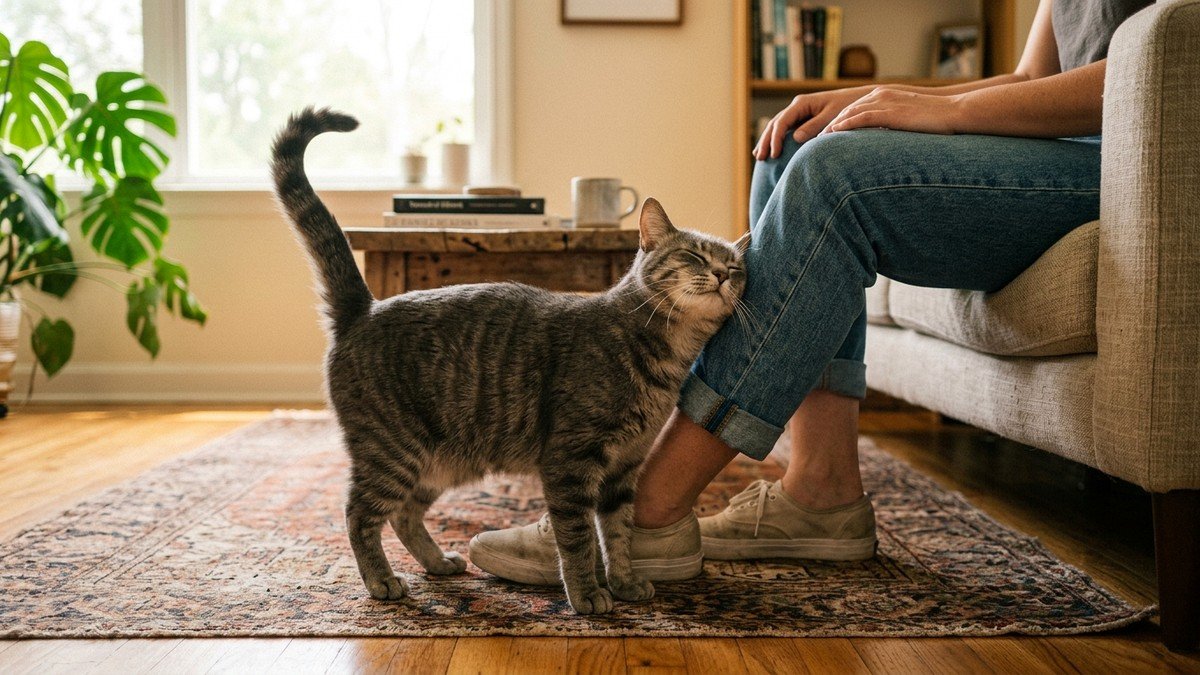
You arrive home from work, unlock your front door, and immediately your cat trots forward with its tail held high like an exclamation point. As you take your first few steps into the hallway, your cat begins weaving in and out of your shins in an intricate figure-eight pattern, pressing its cheeks, flanks, and tail firmly against your legs. This classic feline ritual, known clinically as bunting and allorubbing, is one of the most sophisticated chemical communication systems in the animal kingdom.
Key Behavioral Truth
Leg rubbing is not mere physical affection. It is an olfactory scent-exchange protocol where your cat claims you as a trusted family member, replacing outside odors with its communal household pheromones.
1. The Anatomy of Feline Scent Glands
Cats view the world primarily through complex chemical scent landscapes. While human beings navigate through sight and sound, felines possess an olfactory sensitivity thousands of times more acute than ours, complemented by the specialized vomeronasal (Jacobson’s) organ on the roof of the mouth.
Cats possess specialized sebaceous scent glands positioned along strategic anatomical zones:
- Perioral Glands: Clustered around the corners of the lips.
- Temporal Glands: Located on the temples between the eyes and the base of the ears.
- Submandibular Glands: Situated beneath the chin.
- Caudal Glands: Concentrated along the dorsal surface at the base of the tail.
When your cat rubs its face, body, and tail in sequence against your legs, it creates a continuous biological brushstroke, depositing pheromones known as feline facial fraction F4, which convey emotional security and familiarity.
2. Creating the Communal Colony Scent
In natural feral cat colonies, cooperative members engage in allorubbing (mutual head rubbing) to blend their individual scent profiles into a single communal colony scent. This shared group odor allows colony members to identify friends in the dark and detect intruders instantly.
When you return home from work or outdoor errands, your clothing carries alien scents of vehicle exhaust, unfamiliar dogs, and outdoor flora. By rubbing against your trousers, your cat actively strips away unfamiliar odors and re-anoints you with the clan scent, reaffirming that you are part of its safe family unit.
3. Tail Wrapping: The Ultimate Feline Affiliation
As your cat weaves between your legs, pay close attention to its tail. A tail held straight up in the air with a slight crook at the tip is the universal feline sign of confident, friendly approach. When the cat wraps the tip of its tail around your ankle or calf, it is performing an explicit tactile hug.
In cat colonies, mutual tail wrapping is reserved exclusively for cats that share close social bonds. Receiving this greeting confirms that your cat feels safe, bonded, and completely secure in your presence.
Feline Rubbing Behaviors and Chemical Messages
Review how different forms of rubbing convey distinct communicative goals:
| Rubbing Style | Glands Utilized | Primary Function | Feline Emotional State |
|---|---|---|---|
| Head Bunting (Forehead) | Temporal & frontal glands | Affectionate social bonding | Affectionate and deeply relaxed |
| Cheek & Lip Rubbing | Perioral sebaceous glands | Familiar scent marking | Territorial comfort and safety |
| Full Body Flank Sweep | Caudal & lateral body fur | Scent blending with human | Colony affiliation and welcome |
| Tail Wrap Around Legs | Caudal tail glands | Physical embrace and greeting | Supreme happiness and trust |
Helpful Related Guides for Cat Owners
Learn how to decode subtle feline affection signals by exploring our detailed guides on why cats sleep on your chest and the real science behind cat purring.
5. Chemical Ecology: Bunting Glands and Pheromone Maps
When a cat wraps their body around your ankles, weaves between your shins, and presses their cheek against your denim jeans, they are engaging in head bunting (headbutting) and allorubbing. This behavior is rooted in specialized cutaneous sebaceous scent glands:
- Perioral Glands: Located around the lips and chin, releasing comforting facial pheromones that communicate peace and social affiliation.
- Temporal Glands: Positioned on both sides of the forehead between the eyes and the base of the ears, actively pressed when headbutting your knees.
- Supracaudal (Tail) Glands: Clustered near the base of the tail, releasing lipid secretions when your cat curls the tip of their tail firmly around your calves.
These chemical secretions are imperceptible to human nostrils, but to your cat, they create an aromatic passport. By rubbing your legs after you return from work, your cat replaces foreign outdoor scents with familiar home pheromones, welcoming you back into the collective territory.
6. The Communal Scent Matrix in Feline Colonies
In natural feline social structures, cats living in harmony share a composite group odor known in biology as a group scent matrix. Members of a colony routinely greet one another by rubbing flank to flank, weaving their tails, and touching noses:
When you enter your front hallway carrying grocery bags, package boxes, and outdoor dirt, you smell completely alien. Rubbing against your legs is not just affection; it is scent harmonization. Your cat is actively reapplying their chemical seal of approval, ensuring the entire household maintains a single harmonious olfactory identity.
7. Temporal Entrainment and Mealtime Demands
Notice how leg-rubbing intensifies dramatically when you step into the kitchen near breakfast or dinner time. In behavioral psychology, this is known as temporal entrainment:
- Operant Conditioning: Your cat quickly learns that weaving between your shins slows your walking stride, commands 100 percent of your visual attention, and reliably triggers you to pick up the can opener or kibble scoop.
- Acoustic Accompaniment: Mealtime leg-rubbing is almost always paired with solicitous purring and high-pitched chirp-meows that mimic the acoustic acoustic cry of human infants, making it biologically irresistible for humans to ignore.
8. The Feline Consent Test: Respecting Petting Zones
While a cat rubbing against your legs is asking for social engagement, owners frequently make the mistake of scooping the cat up or petting them too aggressively on the stomach, triggering petting-induced overstimulation biting. Follow these feline consent principles:
- The Finger Sniff Test: Lower a loose index finger to your cat’s nose level. If your cat leans in and rubs their cheek against your knuckle, consent is given. If they pull their head back, respect their boundary.
- Green-Light Petting Zones: Concentrate strokes around the base of the chin, along the jawline, behind the ears, and across the forehead where facial scent glands reside.
- Red-Light Petting Zones: Avoid touching the lower abdomen, groin, and hind legs. The base of the tail should only be lightly scratched if the cat arches their back upwards in enjoyment.
Frequently Asked Questions (FAQs)
1. What is head bunting in cats?
Head bunting, clinically known as bunting or allorubbing, is when a cat gently nudges its forehead, cheeks, and lips against a human or companion animal. It is a profound social greeting and scent-marking behavior signifying safety and belonging.
2. Where are a cat’s primary scent glands located?
Cats have specialized sebaceous scent glands located on their cheeks (perioral), between their ears and eyes (temporal), at the base of the tail (caudal), and between their front paw pads. Rubbing transfers chemical pheromones to objects and humans.
3. Why do cats wrap their tail around your legs while rubbing?
Wrapping their tail around your calves is the feline equivalent of holding hands or sharing a hug. It is a sign of high social bonding, affection, and mutual affiliation.
4. Does a cat rub against your legs because it wants food?
While leg rubbing often intensifies around mealtime as a learned operant behavior to solicit food, the core instinct is an affectionate greeting confirming that you are a trusted provider and family member.
5. Why does my cat groom itself immediately after rubbing on me?
When a cat grooms its fur after rubbing against your clothes or skin, it is tasting your personal scent molecules and integrating your olfactory signature with its own scent, reinforcing the communal group odor.
6. Can outdoor cats mark humans as territory?
Yes. When feral or outdoor cats rub on humans, they deposit pheromones that signal to other neighborhood cats: This human belongs to our social colony and is safe.
Why do cats immediately lick their fur after rubbing against your legs?
Licking grooming immediately after leg rubbing allows the cat to taste and process your scent molecules through their Jacobson’s organ while realigning any displaced hairs on their coat.
Can aggressive leg rubbing be a trip hazard for elderly owners?
Yes. Feline figure-eight shin weaving is a significant domestic fall risk for senior adults. Training cats to target a designated mat beside the kitchen door prevents tripping.