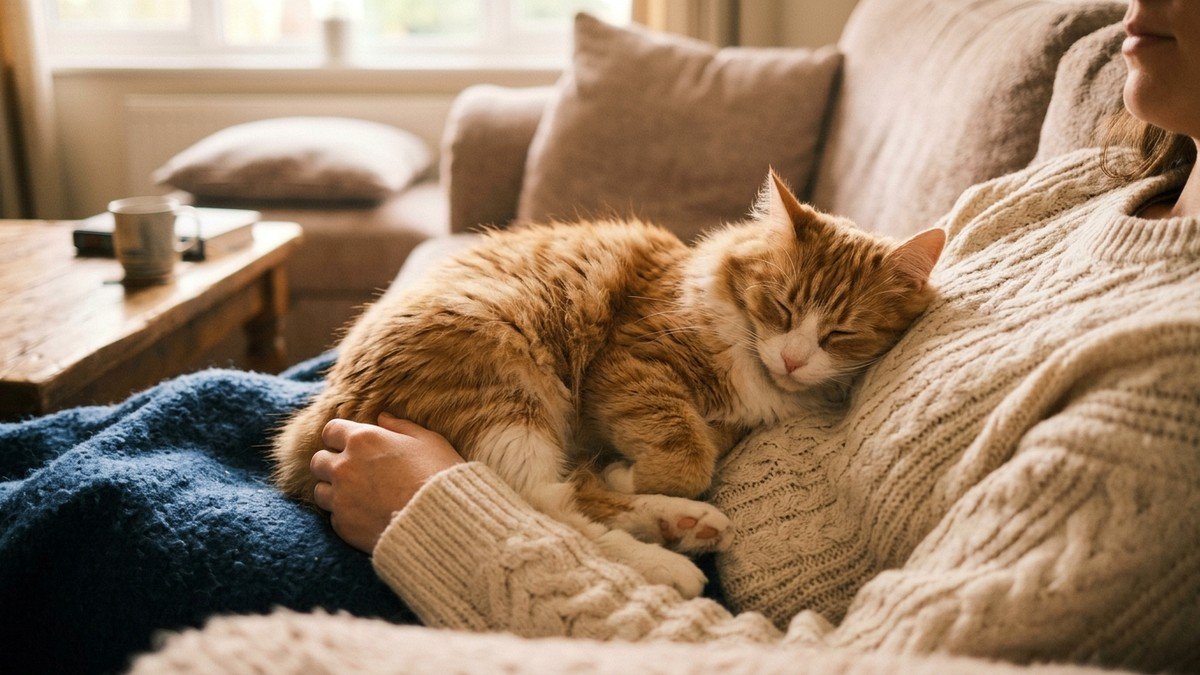
You recline on the living room sofa after a demanding day or settle into bed for the evening, and within moments, a gentle set of paws steps onto your ribs. Turning in three deliberate circles, your cat folds itself into a compact loaf directly over your sternum, tucks its nose into your collarbone, and unleashes an engine-like purr. While waking up with ten pounds of furry weight on your lungs can be surprising, feline ethologists confirm that sleeping on your chest is one of the most intimate, biologically complex behaviors a cat can display.
Key Behavioral Truth
A cat sleeping on your chest is seeking three vital elements: intense thermal heat to support its 102-degree baseline body temperature, the calming auditory frequency of your heartbeat, and profound emotional security.
1. Superior Thermoregulation and Heat Conservation
To understand feline sleeping habits, one must examine their evolutionary physiology. The normal baseline body temperature of a domestic feline ranges between 101.0 and 102.5 degrees Fahrenheit, significantly higher than the human average of 98.6 degrees. Because cats possess high metabolic baselines, conserving body heat requires continuous physical effort.
The human chest, along with the head and neck, serves as a primary radiator of core vascular warmth. When a cat perches on your chest, it absorbs your ambient thermal energy, allowing its metabolic system to conserve calories during deep sleep cycles.
2. Maternal Memory and Heartbeat Rhythms
During the first three weeks of life, neonatal kittens are blind, deaf, and unable to regulate their own body temperature. They survive entirely by piling together atop their mother’s warm chest and abdomen, orienting themselves by the steady cadence of maternal heartbeats and rhythmic diaphragmatic breathing.
In adult companion cats, lying on an owner’s chest reactivates these deeply comforting kittenhood neural pathways. The steady thud of your pulse and the gentle rise and fall of your lungs act as an organic biofeedback mechanism, dissolving stress and prompting immediate purring.
3. Complete Vulnerability and Deep Trust
Cats are both apex predators and small prey animals. In natural environments, entering deep sleep is fraught with peril. An animal cannot monitor its surroundings or react instantly to ambushes while asleep.
By choosing your chest as an elevated sleeping berth, your cat demonstrates complete psychological surrender. It trusts that you will protect it from any incoming danger, while simultaneously placing itself in a position to guard you from unseen household disturbances.
Cat Sleeping Locations on Humans and Their Meanings
Where your cat chooses to rest on your body conveys distinct behavioral motivations:
| Resting Location | Primary Driver | Emotional Message | Owner Consideration |
|---|---|---|---|
| On Your Chest | Heartbeat, warmth, scent bonding | Ultimate trust and affection | Can restrict breathing for light sleepers |
| Above Your Head / Pillow | Radiant scalp heat, stillness | Seeks stability away from tossing limbs | Clean pillowcases regularly to manage dander |
| In the Crook of Your Knees | Contoured nest, dual-sided warmth | Desires secure boundary and gentle touch | Movement can startle or awaken pet |
| At the Foot of the Bed | Quick escape route, territory view | Companionship with independent exit | Ideal for restless human sleepers |
Helpful Related Guides for Cat Owners
Learn how to interpret other affectionate feline bonding rituals by exploring our comprehensive guides on why cats knead soft blankets and why do cats purr.
5. Human Core Temperature Zones: Why the Chest Wins
To understand a cat’s attraction to your upper body, consider their thermal physiology. A domestic cat’s basal body temperature sits between 100.5 and 102.5 degrees Fahrenheit, roughly four degrees higher than a healthy human. Because maintaining this elevated internal heat requires significant caloric energy, cats constantly seek external conductive heat sources.
While human extremities (feet and hands) fluctuate in temperature and frequently turn chilly at night, the human thorax maintains constant blood perfusion from the ascending aorta and pulmonary arteries. When a cat perches on your sternum, they absorb continuous conductive warmth, allowing their metabolic rate to slow into restorative energy conservation.
6. Feline Purr Biomechanics and Bone Regeneration
When your cat curls onto your chest, their purring vibrates directly through your ribcage. Biomechanical studies reveal that feline purring oscillates at frequencies between 20 Hz and 140 Hz:
- Cellular Regeneration Frequencies: Acoustic vibrations in the 25 to 50 Hz range stimulate cellular repair, increase bone mineral density, and relieve joint inflammation in mammalian tissues.
- Human Cardiovascular Calming: Feeling continuous rhythmic vibrations on the chest activates the human parasympathetic nervous system, lowering systolic blood pressure and slowing resting heart rates within minutes.
- Self-Soothing Neurochemistry: Purring triggers the release of endorphins within the cat’s central nervous system, reducing anxiety, alleviating physical pain, and cementing deep social attachment.
7. Evolutionary Allogrooming and Communal Nesting
In feral and semi-wild cat colonies, related females form cooperative nursery groups known as crèches. Colony members pile together in communal nests, interweaving their bodies to sleep in warm mounds. Ethologists refer to this behavior as pile-sleeping or communal touch.
By selecting your chest, your cat treats you as their primary maternal anchor or high-ranking colony partner. Licking your chin or forehead (allogrooming) while resting on your chest exchanges chemical scent markers, establishing an exclusive family olfactory profile.
8. How to Gently Redirect a Chest-Sleeping Cat
While chest sleeping is affectionate, a ten-pound cat resting on your diaphragm can restrict deep breathing, trigger sleep apnea, or awaken light sleepers. Use these gentle transition strategies:
- The Heated Micro-Fleece Pillow: Place a dedicated cat bolster bed directly adjacent to your pillow or shoulder. Slip an electric pet-safe heating pad set to low beneath a worn fleece sweatshirt that carries your natural scent.
- The Lateral Roll Technique: When your cat steps onto your chest, slowly and smoothly roll onto your side, curling one arm around them to guide them onto the mattress beside your ribs.
- Avoid Abrupt Startles: Never push or shove your cat off your chest abruptly. Sudden rejection creates territorial insecurity, prompting your cat to return more persistently.
Frequently Asked Questions (FAQs)
1. Why does my cat sleep right on my chest instead of next to me?
Your chest offers a unique combination of maximum body heat, soothing rhythmic breathing, and the steady acoustic cadence of your heartbeat. This combination recreates the intense comfort and security a kitten experiences when snuggling against its mother.
2. Does a cat sleeping on your chest mean it loves you?
Yes, resting on your chest is one of the highest compliments in feline body language. Because sleeping places a cat in a vulnerable state, choosing your chest demonstrates absolute trust, affection, and emotional bonding.
3. Is a cat marking you as territory when sleeping on your chest?
Partially, yes. Cats possess scent glands on their cheeks, chin, and paws. When they settle on your chest, kneading and rubbing, they deposit subtle pheromones, integrating your scent into their communal family scent profile.
4. Why does my cat’s weight feel heavier when sleeping on my chest?
When cats enter deep slow-wave and REM sleep, their voluntary muscles lose all tone, causing dead weight distribution. Furthermore, lying flat on your chest compresses your intercostal breathing muscles, making their small frame feel noticeably heavier.
5. Can sleeping with a cat on your chest be bad for your sleep?
For light sleepers or individuals with asthma and pet dander allergies, having a cat on the chest can restrict deep breathing and disrupt sleep cycles. Setting up an elevated heated cat bed right beside your pillow provides a healthy alternative.
6. Why do cats purr while resting on your chest?
Purring on your chest indicates deep contentment and parasympathetic relaxation. Feline purr vibrations (oscillating at 25 to 150 Hz) promote physical healing, reduce feline cortisol levels, and lower human blood pressure.
Is it safe to let a cat sleep on a sleeping baby’s chest?
No, never permit cats to sleep on infants or small children. A cat seeking warmth can inadvertently obstruct an infant’s nose and mouth, posing a fatal suffocation hazard.
Why does my cat stare directly into my face before lying on my chest?
Staring combined with slow blinking is feline communication assessing your responsiveness, reading your facial micro-expressions, and confirming that you welcome close physical intimacy.