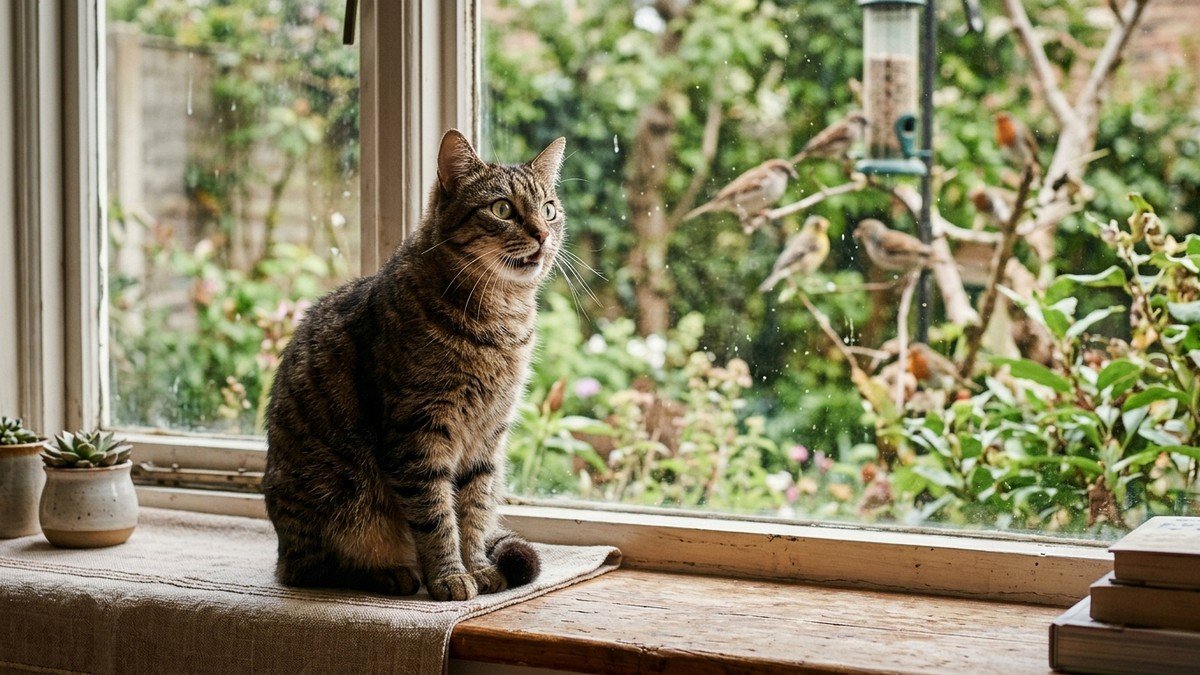
If you share your living space with a cat, you have almost certainly witnessed this mesmerizing phenomenon: your feline companion perches rigidly on the windowsill, eyes dilated like black saucers as a robin or sparrow hops across the garden. Suddenly, your cat begins producing a bizarre, staccato clicking noise with its teeth rapidly vibrating, resembling a tiny typewriter or goat bleat. This distinctive sound, known as feline chattering or chuttering, is one of the most fascinating behavioral intersections of evolutionary biomechanics and cognitive frustration.
Key Evolutionary Discovery
Feline chattering is not random vocalization. It is an instinctual motor pattern that rehearses the specialized killing neck bite while releasing pent-up predatory adrenaline caused by an impassable window barrier.
1. The Biomechanics of the Lethal Neck Bite
To appreciate the mechanics of chattering, one must understand how felines hunt. Unlike canines that rely on crushing bite force or pack exhaustion tactics, felines are surgical dispatchers. When an agile cat captures a small bird or rodent, it delivers a lightning-fast, high-frequency shivering bite directly to the dorsal cervical vertebrae at the base of the skull.
This specialized vibrating jaw action slides the slender canine teeth between the prey’s spinal vertebrae, severing the spinal cord instantaneously without prolonged struggling. When an indoor cat locks onto a fluttering bird, motor neurons in the brainstem fire reflexively, causing the jaw to execute the physical vibration pattern in anticipation.
2. Predatory Frustration and Sensory Arousal
The predatory sequence in felids follows a precise chain: Detect, Stalk, Rush, Pounce, and Kill. When an indoor cat observes a bird through a glass windowpane, the first step is intensely stimulated. Massive surges of dopamine and adrenaline flood the feline nervous system.
However, the glass window represents an impassable physical barrier. Because the cat cannot complete the physical sequence, extreme emotional tension builds up. Chattering acts as an involuntary displacement release, blowing off predatory steam generated by the unconsummated hunt.
3. Vocal Mimicry in Wild and Domestic Felids
For many years, behavioral scientists dismissed the idea that cats mimic prey. However, a landmark study conducted by the Wildlife Conservation Society (WCS) documented wild margays in the Amazon mimicking the distress calls of baby tamarin monkeys to lure adults into ambush range.
Domestic cats exhibit similar acoustic adaptations. The chirping, clicking notes produced during bird-watching closely match the frequency bands of avian distress calls, potentially serving as an evolutionary deceptive mechanism to pique prey curiosity before striking.
Feline Window Watching Behaviors Decoded
Understand the subtle body language signals your cat displays at the window:
| Physical Signal | Underlying Physiology | Psychological Meaning | Recommended Management |
|---|---|---|---|
| Rapid Jaw Chattering | Cervical bite motor neuron firing | High predatory arousal / anticipation | Engage with feather wand lure after window watching |
| Twitching Tail Tip | Sympathetic autonomic surge | Growing emotional frustration | Provide mental outlets like puzzle treat toys |
| Flattened Whiskers & Low Crawl | Stealth stalking posture | Executing hunt phase of predatory cycle | Ensure windowsill has secure, non-slip mat |
| Redirected Hissing at Other Pets | Adrenaline overflow | Redirected territorial aggression | Separate cats until arousal subsides; lower blinds |
Helpful Related Guides for Cat Owners
Learn how to satisfy your feline’s instinctual drives with our expert guides on why cats knock things over and how to introduce cats peacefully.
5. The Neurobiology of the Cervical Disarticulation Bite
To fully decode feline chattering, we must examine the physical mechanics of the specialized feline killing bite. Unlike canines that tear or shake prey violently, small wildcats and domestic felines dispatch avian and rodent prey with precision surgical accuracy:
- Canine Tooth Morphology: A cat’s conical canine teeth are packed with highly sensitive periodontal sensory receptors that can detect the exact microscopic gap between cervical vertebrae.
- The Rapid-Fire Severing Bite: Once jaw contact is established, the cat executes a rapid-fire vibrating jaw movement that slips between the prey’s neck bones, instantly severing the spinal cord with zero physical struggle.
- Involuntary Motor Mimicry: When a cat watches a bird through glass, visual stimulation triggers the motor cortex to fire the exact neural sequences of the killing bite in anticipation, causing their jaw to vibrate rapidly even though prey remains physically untouchable.
6. Dopamine Surges and Barrier Frustration
When a cat watches fluttering sparrows through a window pane, their brain experiences a massive surge of dopamine, the neurochemical driving anticipation, arousal, and intense focus. However, when the physical glass barrier blocks the completion of the hunt, frustration ensues:
In ethology, this state is known as displacement behavior. The animal is flooded with predatory adrenaline but cannot physically execute the motor sequence. The vocalized stutter and jaw chatter act as an acoustic pressure-relief valve, dissipating intense sympathetic nervous system arousal.
7. Acoustic Deception and Ultrasonic Call Hypotheses
In 2005, wildlife biologists in the Amazon basin documented a wild margay cat (Leopardus wiedii) acoustically mimicking the cries of an infant pied tamarin monkey to lure adult monkeys into an ambush. This discovery sparked scientific exploration into whether domestic cat chattering serves as acoustic camouflage.
Acoustic bio-spectrograms show that the clicking, chirp-like frequency of cat chattering mirrors the high-frequency distress chirps of juvenile passerine birds. While domesticated cats chatter instinctively through window glass, their ancestors may have utilized subtle chirps to calm foraging birds in foliage until striking distance was achieved.
8. Completing the Predatory Cycle with Structured Play
Leaving a cat to chatter through a window without closure can result in redirected aggression, where the frustrated cat swats at nearby family members or pets. Provide healthy physical closure using the predatory sequence framework:
- Engage with Feather Wand Toys: Move a feather wand toy (such as Da Bird) in erratic flight patterns across the room immediately after a window chattering session.
- Allow Physical Capture: Let your cat pounce on, bite, and grapple the feather toy with their front paws and kick with their back legs (the final kill sequence).
- Reward with Protein-Rich Food: Immediately following the toy capture, feed a high-protein treat or can of wet food. In feline neurobiology, Eat-Groom-Sleep completes the hunt cycle, bringing deep contentment.
Frequently Asked Questions (FAQs)
1. Why does my cat’s jaw vibrate when it sees a bird?
Rapid jaw chattering is an involuntary neurological motor pattern mimicking the lethal neck bite (specialized cervical severance) that wild felids use to instantly dispatch small prey. Watching birds through glass triggers this predatory reflex.
2. Are cats frustrated when they chatter at birds through a window?
Yes, predatory frustration is a major catalyst. The cat’s sensory systems detect prey and stimulate a surge of dopamine and adrenaline, but the glass barrier physically prevents the stalk and capture sequence from completing.
3. Do cats try to mimic bird sounds when chattering?
Scientific research confirms vocal mimicry in wild felines. Field studies in the Amazon recorded wild margay cats imitating the cries of pied tamarin monkeys to lure them closer. Domestic cats may produce chattering tones that acoustically resemble avian chirps.
4. Is chattering at birds harmful to my cat?
No, chattering is completely normal instinctual behavior. However, if your cat becomes overly fixated, paces frantically, or redirects aggression onto other pets, redirect their energy into interactive feather wand play.
5. Do all domestic cats chatter at prey?
While most cats exhibit chattering, individual expression varies based on genetics, hunting drive, and early kitten development. Some cats merely stare silently with dilated pupils, while others vocalize passionately.
6. Can chattering occur with toys instead of live birds?
Yes, cats frequently chatter at laser pointers on walls, feather wand lures moved rapidly above their reach, or flying insects caught high near the ceiling.
Do cats ever chatter at laser pointers?
Yes. Chattering frequently occurs during laser pointer sessions because the intangible red dot stimulates intense predatory pursuit without ever offering tactile capture, fueling identical barrier frustration.
Why does my cat’s tail swish violently while chattering at birds?
A rapid, thumping tail indicates high sympathetic emotional arousal and internal conflict between intense predatory excitement and physical inability to catch the bird.