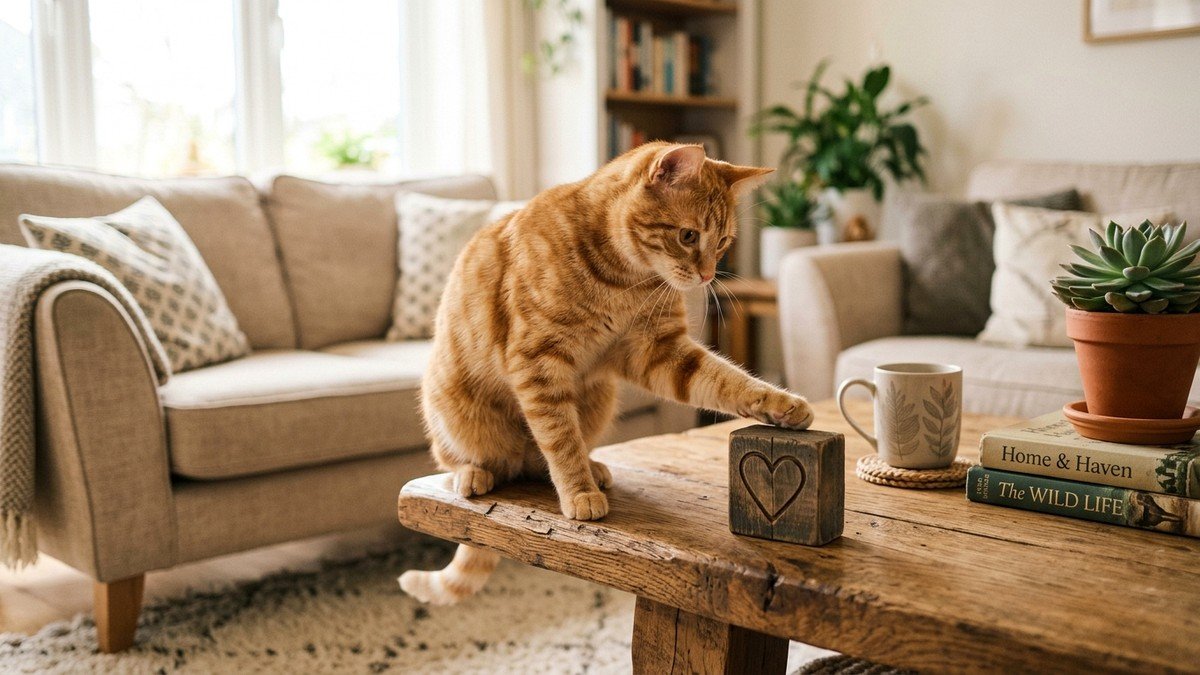
It is one of the most celebrated and perplexing behaviors in the feline world: a cat sits perched atop a desk, slowly extends a paw toward a pen, glass, or decorative ornament, maintains unblinking eye contact with its human, and nudges the item over the precipice to watch it crash to the floor. While this antics-filled habit inspires countless internet memes, it is deeply rooted in evolutionary biology, sensory exploration, and cognitive operant conditioning.
Key Behavioral Insight
Cats do not knock objects over out of malice or spite. What appears to be mischief is a combination of prey-testing instincts, tactile investigation using hyper-sensitive paw pads, and operant conditioning where human reactions reinforce the behavior.
1. Predatory Drive and Prey Testing Instincts
In the wild, small felines survive by hunting agile prey such as mice, lizards, frogs, and insects. When a wild cat encounters an unfamiliar or seemingly lifeless creature, it does not immediately pounce with its jaws. Instead, it extends a front paw to gently bat and nudge the target.
This gentle swatting tests whether the object is alive, injured, or capable of striking back. If the creature scampers or flutters, the predatory sequence advances into chase and capture. In a modern domestic living room, pens, keys, lip balms, and cups serve as surrogate prey. When your cat bats a pencil across a tabletop and it rolls over the edge, the ensuing motion triggers an instinctual dopamine release in the feline brain.
2. Sensory Perception and Paw Pad Exploration
A domestic cat’s paws are remarkably sophisticated sensory organs. Feline paw pads are packed with dense concentrations of specialized nerve endings known as Merkel nerve endings and tactile Pacinian corpuscles. Furthermore, cats possess carpal vibrissae, which are stiff tactile whiskers located on the back of their front wrists.
When a cat touches an object on your nightstand, it gathers complex sensory data regarding texture, weight, balance, temperature, and resistance. By tapping an object repeatedly until it tumbles, the cat evaluates gravity, acoustics, and speed, satisfying an innate curiosity about its physical environment.
3. Human Operant Conditioning and Attention Seeking
Cats are observant masters of cause-and-effect learning. Imagine this sequence from your cat’s perspective: your cat rests quietly on the kitchen counter while you stare into your smartphone or work on a computer. The cat receives zero attention. The cat then approaches a glass tumbler and rests its paw on it.
Instantly, you gasp, shout your cat’s name, leap out of your chair, and rush toward the counter. In animal behavior science, this is known as positive reinforcement. Even if your response involves scolding or moving the cat away, from the cat’s perspective, touching the object generated instant, high-energy human interaction. Once a cat learns this connection, swatting objects becomes a reliable tool to demand meal service or playtime.
4. Boredom and Inadequate Environmental Enrichment
Indoor cats are obligate carnivores with complex mental capacities. When confined to an unstimulating environment devoid of vertical climbing territory, foraging puzzles, or structured play, boredom rapidly manifests as destructive behavior.
Knocking items off shelves creates sudden noise, surprising movement, and temporary excitement in an otherwise static indoor environment. If your cat frequently engages in this habit during the early morning hours, it is a clear signal that their daily energy reserves are underutilized.
Feline Motivation vs Management Strategy
Understanding the precise catalyst behind your cat’s behavior allows you to apply targeted, humane environmental modifications:
| Primary Driver | Typical Object | Observed Cat Behavior | Effective Solution |
|---|---|---|---|
| Predatory Play | Pens, dice, bottle caps | Watches item bounce and chases it down | Provide rolling cat springs and puzzle balls |
| Attention Seeking | Water glasses, mugs, phones | Looks directly at owner before nudging | Extinguish reaction; initiate play on your schedule |
| Environmental Navigation | Books, picture frames on ledges | Shoves items aside to clear walking path | Clear walking paths on shelves and cat shelves |
| Understimulation / Hunger | Items on nightstand early morning | Knocks items until owner leaves bed | Use timed automated feeders for dawn meals |
5. How to Cat-Proof Your Home and Redirect the Habit
To protect your valuables and channel your cat’s energy constructively, implement these proven behavioral strategies:
- Secure Decor with Museum Putty: Use non-toxic museum putty or collector’s wax under the bases of valuable decor, electronics, and picture frames. This eliminates the item’s movement, extinguishing the cat’s interest.
- Establish Dedicated Wand Toy Sessions: Schedule two 10 to 15 minute interactive play sessions daily using feather wand lures. Allow your cat to stalk, pounce, and capture the toy, finishing each session with a healthy protein meal to satisfy the predatory sequence.
- Deploy Food Foraging Puzzles: Ditch stationary food bowls in favor of treat mazes and slow-feeder puzzle boards. This engages your cat’s intellect and satisfies its tactile paw exploration in an authorized manner.
- Calm Inattention: When your cat prepares to swat an item that is safely secured, avoid dramatic gasps or eye contact. Calmly walk away or redirect them with an authorized toy.
Helpful Related Guides for Cat Owners
Deepen your understanding of fascinating feline body language by reading our comprehensive guides on why cats knead blankets and the real science behind cat purring.
Frequently Asked Questions (FAQs)
1. Why do cats make eye contact before knocking something over?
Direct eye contact while swatting an object is a learned attention-seeking behavior. Cats quickly learn that when they touch an object, humans immediately react with vocalizations, laughter, or movement, effectively granting the cat social interaction.
2. Does my cat knock things over out of spite or anger?
No. Feline psychology is not driven by spite, vindictiveness, or malice. Cats knock objects over driven by hunting instincts, curiosity about sound and movement, physical play, or boredom. Attributing human spite to cats is an anthropomorphic misconception.
3. How can I secure fragile items from my cat?
Pet owners can use clear museum putty or earthquake wax under the bases of vases, picture frames, and knick-knacks. Museum putty bonds items securely to wooden or glass surfaces without causing damage, preventing cats from nudging them off.
4. Why do cats only knock things off at night or early morning?
Cats are crepuscular creatures, which means their peak energy and natural hunting instincts surge at dawn and dusk. If a cat is hungry or desires breakfast, knocking over items on the nightstand or dresser is a guaranteed method to wake their sleeping human.
5. Should I use a spray bottle to stop my cat from knocking items down?
No, veterinary behaviorists strongly advise against water spray bottles. Punishment damages the human-animal bond, increases feline anxiety, and only teaches the cat to avoid knocking items over while you are present in the room.
6. What toys help curb a cat’s urge to bat objects?
Provide interactive wand feather toys, crinkle balls, motorized rolling balls, and puzzle treat feeders. These outlets allow cats to fulfill their natural swatting and predatory drives in an appropriate, engaging manner.